Games as a Site of Resistance
Source: Unsplash
Games, like all forms of art, are inherently political. The types of characters you design, the locations and settings you include, the stories and themes you convey, the choices you allow players to make, the platforms you choose to release on, and where you accept your funding from are all political choices because every decision reflects a worldview, shapes our imagination, and allocates power. Even choosing not to engage politically is a political stance because it reinforces the status quo.
Activism, resistance, and radicalisation are topics often overlooked in games education, where so much focus is on the how (e.g. how to use software and tools) rather than the why of making games. Games don’t exist in a vacuum—as artists and gamemakers, it is vital that we are aware of our surrounding social and political contexts. What we make and how we make it is a reflection of ourselves, our society, and the times we live in. We have an incredibly unique medium through which we get to voice ourselves or be a voice for others, and this is something that we cannot take for granted. How can we call games an ‘artform’ and ourselves ‘artists’ if we are not reflecting on, criticising, resisting, or challenging the status quo? This is why activism, resistance, and radicalisation are so important, and it is for this reason that we must educate ourselves on these topics.
Why now?
We’ve personally known for a long time that games have the potential to convey personal, social, and political stories. It’s always been our ambition to embed our gamemaking practice within a broader artistic context. Since the escalation of the ongoing genocide of Palestinians in Gaza, we especially feel that we can no longer afford to be passive in this climate, as silence in the face of genocide is complicity. As artists and gamemakers, we feel the urge and responsibility to speak to these issues through our medium. In response to this, we’ve found that our work has evolved to embrace political and critical themes at a deeper level. Our interest in activism has really spiked after further researching the injustices that revolve around the ongoing ethnic cleansing, apartheid, and genocide in Palestine. We find ourselves often questioning how we can “do more” through our work in games. Our perspectives and opinions on a lot of cultural, art, games, and education institutions locally and internationally have also become a lot more informed.
We feel we’re at a tipping point. The world is burning, literally and metaphorically. Fascism, authoritarianism, state surveillance, censorship, and repression are all on the rise. We’re witnessing our rights, our democracy, our freedoms, and international law, all eroding. Our ecology is collapsing in favour of capitalism and shareholder value. We have a lot to lose collectively if we’re not engaging with politics, activism, and resistance right now. If we don’t engage now, then what hope do we have for the future? Our games have the potential to move, to motivate, to educate, to provoke, to ask uncomfortable questions, to raise awareness, and to challenge—and we need these games right now, to inform and to inspire the world to act and fight against those who are fuelling the flames. You don’t need to be an experienced gamemaker or artist to start doing this. You just need to start.
Themes of politics, activism, and resistance can take many different shapes and forms in games. They can be explicit and conveyed through narrative and gameplay, as seen in games such as Liyla and the Shadows of War or Papers, Please. They can be more subtle through use of metaphors, abstraction, or allegories, as seen in games like Name of the Will. Or they can be incorporated in the ways in which we carry out our business, by joining a union, conducting cultural consultations where appropriate, or taking an active stance against organisations for their complicity in genocide, apartheid, and ethnic cleansing. Amsterdam-based studio Speculative Agency is an great example of this, returning funding they received from Microsoft for their game All Will Rise when the BDS and No Games For Genocide announced a call to Boycott Microsoft and Xbox.
It is ultimately our responsibility, both as individuals and collectively as a community, to ensure that the organisations we conduct business with are not compromised, silent, or complicit in the face of oppression, and that they are not receiving funding from partners who have blood on their hands. We need to make a habit of checking the donors, sponsors, and philanthropic partners of these organisations both through their websites and their annual reports.
What can gamemakers do?
Gamemakers can start by critically examining the tools and software they use to make their games. Which tools have affiliations with the military industrial complex, have associations with big tech, or have GenAI deeply rooted in them? We’re big fans of Free and Open-Source Software (FOSS), so we encourage gamemakers to seek out FOSS alternatives where possible.
Another practical step is to begin seeking or creating communities that align with your values, embrace activism and resistance, challenge the status quo, and seek to build a future free of all forms of oppression. These groups don’t have to be limited to gamemaking groups, either. Through unity and solidarity comes power.
If you’re looking for other ways in which to support people and communities locally and around the world, here’s a few things you can start doing today:
Educate yourself and others by reading up on history and talking about it
Bear witness and speak up about the injustices that you see around you
Join and actively participate in your union
Follow and share independent news that may otherwise be censored or suppressed
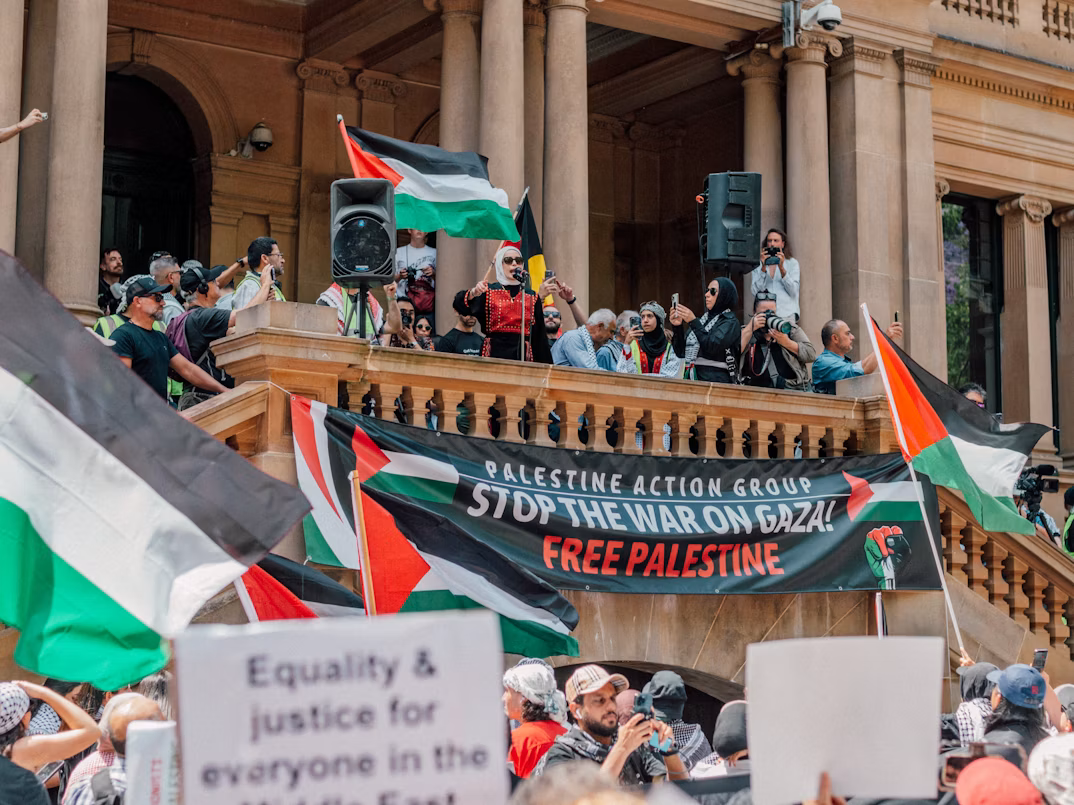
Attend rallies, and if you’re brave enough, volunteer
Call or write to your MP representative
Sign petitions
Apply pressure by joining the Boycott, Divestment, and Sanctions (BDS) movement
Amplify minority and oppressed voices
Donate to charities and organisations dedicated to supporting the oppressed
Share your concerns with friends, family, and work colleagues
Take ownership of your own potential as someone with a unique voice; a voice within a collective choir, whom in unison holds the power to make a difference
If we choose to ignore the issues that surround us, we may unfortunately face a very bleak future. One where people are governed, suppressed, and silenced through fear, state surveillance, and technofascism.
Working within constraints
Beyond the obvious limitations of working on any sort of game—such as time, skills, and funding—there are challenges unique to making work that is political in nature. Often, but not always, government funding bodies—whether they’re local, state, or federal—will be risk averse in the face of highly political work. This is especially the case if the game speaks to themes of geopolitics, oppression, and genocide, and doubly so if it’s to do with Palestine, unfortunately (see: ‘Progressive except Palestine’ and ‘Palestine exception’).
Working on projects like this can also have an emotional toll, and lead to fatigue, stress, or depression, as you’re often working with highly sensitive subject matter. Sometimes these projects will put yourself, your financial stability, or your reputation at risk. There are unfortunately powerful lobby groups who systematically apply pressure on governments and organisations to silence, censor, and suppress artists and projects of this nature. This is so that the machinery of capitalism and colonialism can continue to operate with minimal resistance. Media outlets will often ignore or suppress projects like this as well, as seen in the most recent case of a journalist wanting to cover Dreams on a Pillow by Palestinian gamemaker Rasheed Abueideh, where the piece was “killed before it could be published”. Social media platforms will also suppress, censor, or shadow ban accounts or posts.
All of the above for simply wanting to shed light on the truth. These systems of oppression should infuriate us all, and we should not stay passive or silent in light of it. Staying silent is exactly what the oppressors would like from us.
The strongest and most meaningful decision to make in light of all of the above, is to continue to make, to speak up, and to resist. It’s vital to remember that we are not in this alone, and that there is a global network and movement of people, be it artists, workers, leaders, and regular people, who are aligned in values and in cause. We would encourage gamemakers to cultivate support networks that not only encourage looking out for one another, but to act in tandem and alignment with these larger movements. Expanding your network of collaborators (outside of games) by attending activist workshops and events is a positive step forward. Engage with non-games people, broaden your perspectives, and seek alternative ways of platforming or presenting your games that align with your values.
For students
You can engage with these ideas even during your earliest projects. Try participating in game jams with other jammers and organisers who share similar values, principles, and themes. There’s a bunch already out there. Some of our favourites are:
Protest Games Jam
Games Transformed Jam
Fuck Capitalism Jam
Game jams provide a low stakes way of making experimental and provocative games without the burden of having to make it perfect or polished, or needing to sell it.
For juniors
It can feel especially difficult to engage with these ideas if you’re in a precarious employment situation, like your first games job. If that’s you, firstly make sure you join your union—for gamemakers that would be Game Workers Australia. Secondly, know your rights—ensure you’re familiar with what your workplace’s contractual obligations are before attempting to make or publish political work, and if you think you are being unfairly suppressed in the workplace, seek union and/or legal advice.
Another factor to consider is whether you can find financial stability through other means and not necessarily in games, which would allow you to make games after work hours, without your games being compromised.
Final thoughts
If this all feels overwhelming and you don’t know where to start, that is totally normal. We have all been conditioned by the propaganda machine to feel overwhelmed and powerless, but it’s never too late to connect with your identity, politics, activism, and values, and rise up against this form of oppression. We all start off as a blank canvas, and learn little by little, day by day, and we're all still learning. No one becomes an expert overnight.
The most important part of this journey is to realise that you need to take that first step, to ask yourself, “What mark do I want to leave behind?”. Once you’re on this journey, which in honesty is a life-long commitment of sticking to your values, it’s also important to take breaks from the hustle of activism from time to time, as it truly is a marathon not a sprint.