A Guide to your First Post-Graduation Game
This guide is the final artefact for the research capstone project for the Bachelor of Design (Games) course at RMIT, under the topic “How to start your dream studio?”. For this project I have done academic readings about the production process and business model of indie studios, read case studies of some successful local studios, and interviewed people with industry expertise and peers with various level of experience and motivation. I choose this topic in the hope that it can start the conversation about what we as freshly graduated emerging game devs can do outside of applying for full time jobs, and be more transparent about the reality of the current industry.
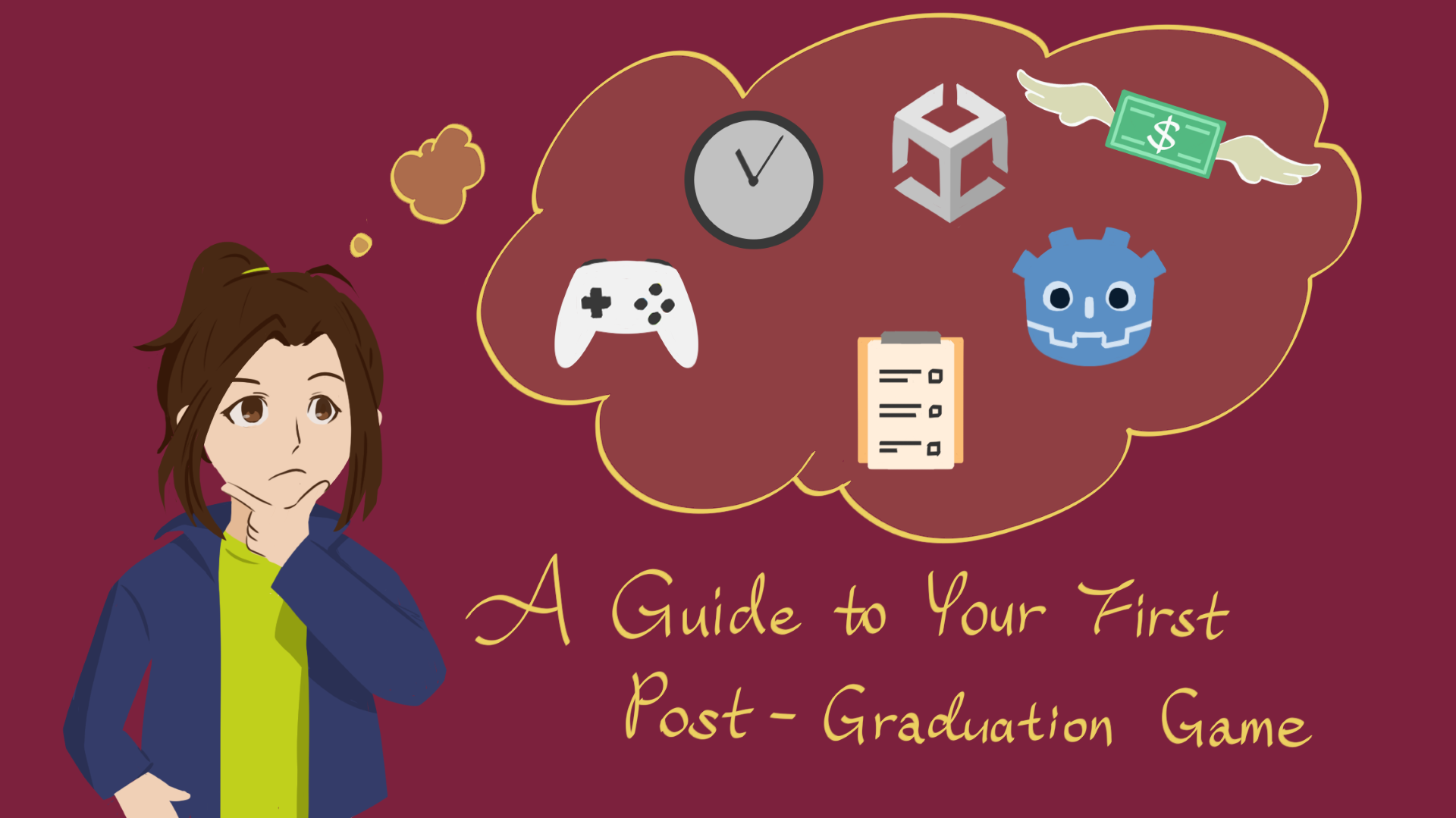
Step 1: Idealization
Many game design students want to make games either on their own or with friends after graduating, whether or not they would be looking for jobs in or outside the game industry. This is partially because the Australian game industry’s lack of job positions and trend towards self-directed production in the game development community (Commonwealth of Australia, 2016). So, how do you make your own game?
What do I want to make?
This is going to be a hard journey. Whatever your goal is, if you want to see it finished, make something that is important to you. If you want to involve other people, you will need to share your passion to align everyone’s creative vision together.
What do I want from this project?
Is this purely out of personal interest? Artistic practice? Or do you want to be the next Balatro? Understanding what you want is crucial, as many decisions on your project plan depends on this and certain decisions would help push this project towards your goal. In a group situation, you would want to make sure everyone understands and respects each other’s personal goal so people can stay committed.
Step 2: Dedication
Most of us at this point already know that making games takes effort. Turning this practice into a small business takes even more, with the amount varying depending on how much reward you want out of this. As the rest of this guide will show you, there are many factors that need to be considered, and they all take time.
Who should I work with?
Working on your own, as we all have learned with experience, is hard. The nature of game production requires multi-disciplined skills and is labour intensive (Xavier et al., 2023). But this also saves you time for production management and allows you to focus on your vision more clearly. Good for: artsy/experimental small projects, passion projects with no time pressure, and stubborn jack-of-all-trades.
Working with friends sounds idealistic. Making art with mates sounds fun right? It could be, in certain situations, but it depends on the individual’s skill and personal motivation. You do have the advantages of knowing each other better, but it also makes it harder to remain professional when problems arise during work. Good for: social creatures, groups with previous co-working experience, people with decent work ethic, and medium projects requiring decent amount of investment.
Working as a sole director while outsourcing certain jobs through contractors or hiring employees is also an option. Similar to working solo, this gives you complete creative control over the project, while having other people filling in for certain aspects of the project you cannot finish on your own. But obviously this requires a decent amount of money. Good for: people with financial support, ambitionists, and auteur wannabes.
How many resources do I want to invest?
The current industry has a really low barrier of entry, with easy-to-access tools and free resources meaning all you need to start making games is a computer. This means that what you mostly need is time, and there are two types of time you can get: volunteered time and paid time.
Before a studio can get funding or makes revenue, all the production costs are made up by volunteered time. Most people will only have so much free time to invest in this project in a given period and this is most likely all you have access to before you can make a presentable prototype to pitch for funding. If you are lucky to be in a good position financially, it can speed things up significantly by either allowing you to invest more of your time or pay for someone else’s time. Either way, be prepared to invest in a lot of resources before you get anything in return, if that is what you have set out to do.
Your answer to this question would be a balance between how much spare time you have after other commitments, how much money are you happy to sink into this project, and how fast you want something to happen.
Step 3: Operation
Once you know what you are working with, it’s time to make a plan for actually making your game. Of course, if you are working on your own with no expectation of outcome, you can always ignore this step because you can afford to work on your project one step at a time.
How do I structure my project production?
It’s time to make a roadmap. Where do you want to be at what stage? If you want external support, do they have a timeline they are working with? You would want to consider what they will be asking from you at what times, which will add a rough timestamp to your roadmap. Even without external factors, there might be a limit on how long you or your team is planning to invest in this project, so it will be helpful to break the project into stages to help make the project happen.
There are different ways time can be structured and experienced (Pelletier, 2023). If you need to work with third parties for funding, it is inevitable that you will be working with “chronological time”, which is characterised by pressure, emotional labour, and externally structured schedules. When you are motivated by your personal goal, or a shared vision of the group, times are spent “teleologically” out of commitment and people’s own will. And then there’s “narcissist time”, which is where people choose to spend time out of their own moment-to-moment satisfaction. Depending on how important external support is in your project, the ratio of these types of time spent will vary, but it is very important to save some space for the last two types on your timeline as they are the source of people’s passion and motivation.
What else do I need to manage apart from the game itself?
Apart from making the game itself, there are other things that need to be done that also take resources. Someone needs to make sure that everyone has what they need to work according to plan, and this job takes time. If money is involved, you will need to make documents to either receive or pay money and keep track of your cash flow, which also takes time. If you are going to market your game, it is going to take even more time. These are all jobs that you can attempt to resolve within your existing team or outsource to professionals, but you need to budget the time or money needed into your plan.
Step 4: Commercialisation
Yes, we all hate capitalism here. But if you ever want to make a bigger game, you are going to need more than your volunteered time. It’s common to think that being an indie developer means we make games independently, but there are different ways a game studio can be independent. You can be financially independent, creatively independent, or distribution independent, but being one of them means that you would very likely be dependent in other aspects (Ruffino, 2023). The game industry can be seen as an ecosystem and indie game developers are only part of it, which means to participate in the scene, you interact with others in the same ecosystem (Xavier et al., 2023).
How can I get extra resources?
The most popular choice for indie studios in Australia is government funding. If you get money this way, you have no obligation to repay anything. It is competitive to receive this funding, but so is every other method. They are most popular because they provide the most independence, as all you need is to meet milestones and you’ll get financial support.
Crowdfunding is easier to attempt because all you need is access to a crowdfunding platform. However, it does mean it’s even more competitive if you need a decent amount of money because of how easy it is to set up. The benefit is that you can receive government funding and crowdfunding at the same time, and there are studios using government funding to launch a bigger crowdfunding campaign. It is also adaptable to your scope. You can find someone’s hobby project on Kickstarter and also AAA-standard games like Divinity: Original Sin 2. This means you don’t need to rely on a third party for money, but you will be relying on the community, which would in turn influence your creative decisions.
Finding a publisher is another standard way to receive financial help. They can often provide other resources too, like QA, marketing, and localization support. But the downside is that they will expect repayment. Depending on the contract, you will be expected to “recoup” their investment in your game, which means that when your game starts making revenue, they will take a predetermined cut from it until they have gotten back all the money they have invested in you. This rate is often 100% for a new studio, which means you are not getting anything back until you have completely repaid them. After everything is paid off, they will take a smaller cut from revenues, but it may still be around 50%. However, even if they take a massive cut from money that could have been yours, a legitimate publisher usually will boost sales drastically, which will benefit you. You will need legal support to help you make this decision to make sure you sign a beneficial contract. How much independence you have with a publisher varies based on which one you choose and how much support you need, but generally speaking they can free you from worrying about some areas of development.
What happens after my game is done?
Most of us want people to play our game, and marketing is the way to let people know what you have to offer. It is important to know what you want your marketing to do. Do you want people to check out your demo? Spend 20 dollars to buy your game? Or start raising a trend on TikTok? Consider what would benefit your project goal more, who would be interested, and what you can budget for. Putting pamphlets in people’s mailbox in your neighbourhood is likely pointless because games are generally not location-based, but sending a free download key to a gaming Youtuber might boost your sales 200%.
Depending on your funding method, the effort you need to invest will vary a lot. With government funding is entirely depends on how much you want to get out of the time you’ve spent making your game. If you are doing crowdfunding, marketing is everything and you will want someone who has marketing knowledge on your team to handle it. If you are with a publisher, they usually handle that for you but, as previously mentioned, it comes with a cost.
How much can I get from my effort?
This is the part where you get paid! If you are not focusing on making money from your game, just be happy about it. If you want to get paid for your labour or fund your next project without external source, you should look into this aspect before putting your game on Steam. In the sales you’ve made from your game, approximately 30% will go to the platform you’ve published on (except itch.io), 25% will go to tax, and your publisher will take the amount you’ve agreed to on the contract. This means that if your game makes 100 dollars, you’ll only get around 45 dollars under your studio’s name, provided you didn’t get a publisher. Your actual profit from that scenario would be even less, as you have probably invested in marketing to get your game to the players and other expenses as well.
Step 5: Regulation
There are legal aspects that you need to consider to make sure things goes smoothly when dealing with third parties or even with your own team.
What do we need to consider as a studio?
If you are involving money in the project, you need to consider what legal entity your group is operating under. If you are planning to receive funding, you need to be check the requirements of the funding body. They may require you to be a sole trader or a company, for IP reasons (Vicscreen, 2025). If you are crowdfunding or self-funding with savings or volunteered time, you can be whatever entity you want, but it is usually recommended to register a company as this means you will be more protected if there are any legal issues.
What do we need to consider between each other?
If you are involving any people other than yourself in the project, whether it’s co-owning the studio or outsourcing tasks, you want to be clear what is everyone’s right and obligation. This is where a contract comes in. Topics it should cover includes:
Intellectual property: Who owns the copyright of the project? Who do the assets made during this project belongs to? Who will have the right to use them and to what extent?
Financials: Is anyone getting paid? If so, how much and when? For hired help, this is usually a fixed amount by project or by work hour. For people who share the studio, this will depend on the situation. If the project has a decent amount of funding, some people will prefer having wages during development. After everything is paid off, how are people splitting the profit?
Responsibilities: What is expected from each team member? At what time?
Termination: What happens when someone wants to leave the studio? What if someone breaks the contract?
You might think that you don’t need a written contract between friends, but this is more an act of precaution and protection than distrust. People are more likely to assume things from their friends and a contract clarifies these, helping everyone stay professional in a working situation (A. Cole, personal communication, September 03, 2025).
Reference List
Commonwealth of Australia. (2016). Game on: more than playing around: The future of Australia's video game development industry. https://www.aph.gov.au/Parliamentary_Business/Committees/Senate/Environment_and_Communications/Video_game_industry/Report
Pelletier, C. (2023). How time flows making games: An ethnographic analysis of experiences of temporality in an indie videogame studio. European Journal of Cultural Studies, 27(6), 1194-1210. https://doi.org/10.1177/13675494231217053
Ruffino, P. (2023). Indie Games. In B. Perron & M. J. P. Wolf (Eds.), The Routledge Companion to Video Game Studies (2nd ed., pp. 104–111). Routledge. https://doi.org/10.4324/9781003214977-16
Vicscreen. (2025). Victorian Production Fund – Games Guidelines. https://vicscreen.vic.gov.au/images/uploads/Funding_Programs/Guidelines/VPF_Games_Guidelines_2025-26.pdf
Xavier, B., Viana, D., Santos, R. (2023). Business Model for Indie Studios in Game So[ware Ecosystems. In R.P.d Santos & M.d.S. Hounsell (Eds.) Grand Research Challenges in Games and Entertainment Computing in Brazil - GranDGamesBR 2020–2030. Springer. https://doi.org/10.1007/978-3-031-27639-2_3